Top Attractions in Bilbao – Part 1
Bilbao is associated all over the world primarily with the Guggenheim Museum—a modern and unusual building that often tops lists of the most important attractions in Spain. But this city has much more to offer than just one museum. We have beautiful cathedrals here, we can walk the atmospheric streets of the Old Town, and relax in beautiful districts full of small squares and greenery.
An interesting fact is that many Basques do not consider themselves Spaniards and emphasize their cultural and linguistic distinctiveness. This atmosphere is also visible in Bilbao: in everyday life, traditions, and the Basque language, which does not resemble any other language in Europe. Below you will find 20 attractions that are really worth seeing while in this city. Here is part one.
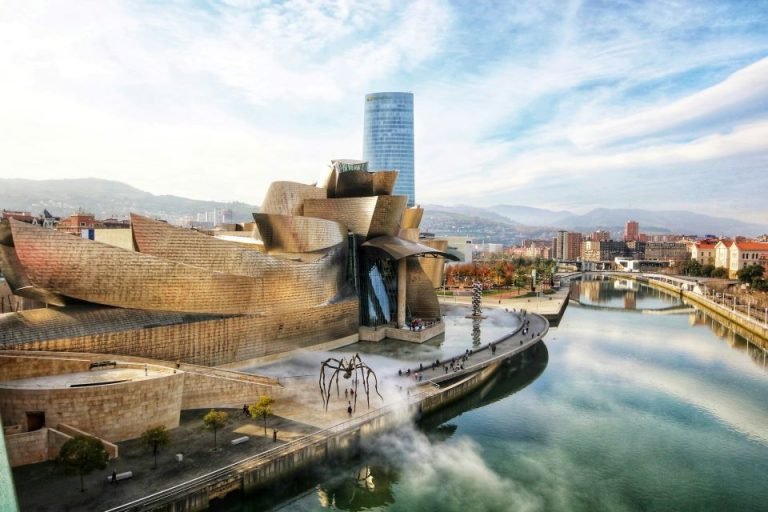
1. Guggenheim Museum
The world-famous Museum of Modern Art, which has been a symbol of Bilbao for years, is obviously at the top of the list. The collection is presented in an impressive building designed by architect Frank Gehry and opened in 1997. Located on the river, the museum resembles a ship. The permanent exhibition focuses on 20th-century art and includes mainly installations, abstract works, and avant-garde pieces.
2. Plaza Nueva (New Square)
Plaza Nueva is a typical spot found in many Spanish cities that serve as capitals of autonomous regions. The square is a closed courtyard surrounded by a gallery. Under the arcades, there are cafes and tapas bars where you can sit and relax. On Sundays, a market is held here where old books, coins, stamps, and posters are sold.
3. Vizcaya Bridge (Puente de Vizcaya)
An unusual transporter bridge that moves passengers from one side of the river to the other using a suspended gondola. The structure was erected in 1893 based on a project by a student of the famous engineer Gustave Eiffel. With the help of a special lift, passengers can access the upper walkway to see the surrounding area.
4. Zubizuri Bridge (Campo Volantín Bridge)
The Campo Volantín is a modern suspension bridge designed exclusively for pedestrians. It was built in 1997 according to a design by the famous architect Santiago Calatrava. The bridge has become one of the symbols of modern Bilbao and attracts many tourists. Unfortunately, when it rains, the glass surface becomes slippery and can be dangerous.
5. Artxanda Funicular
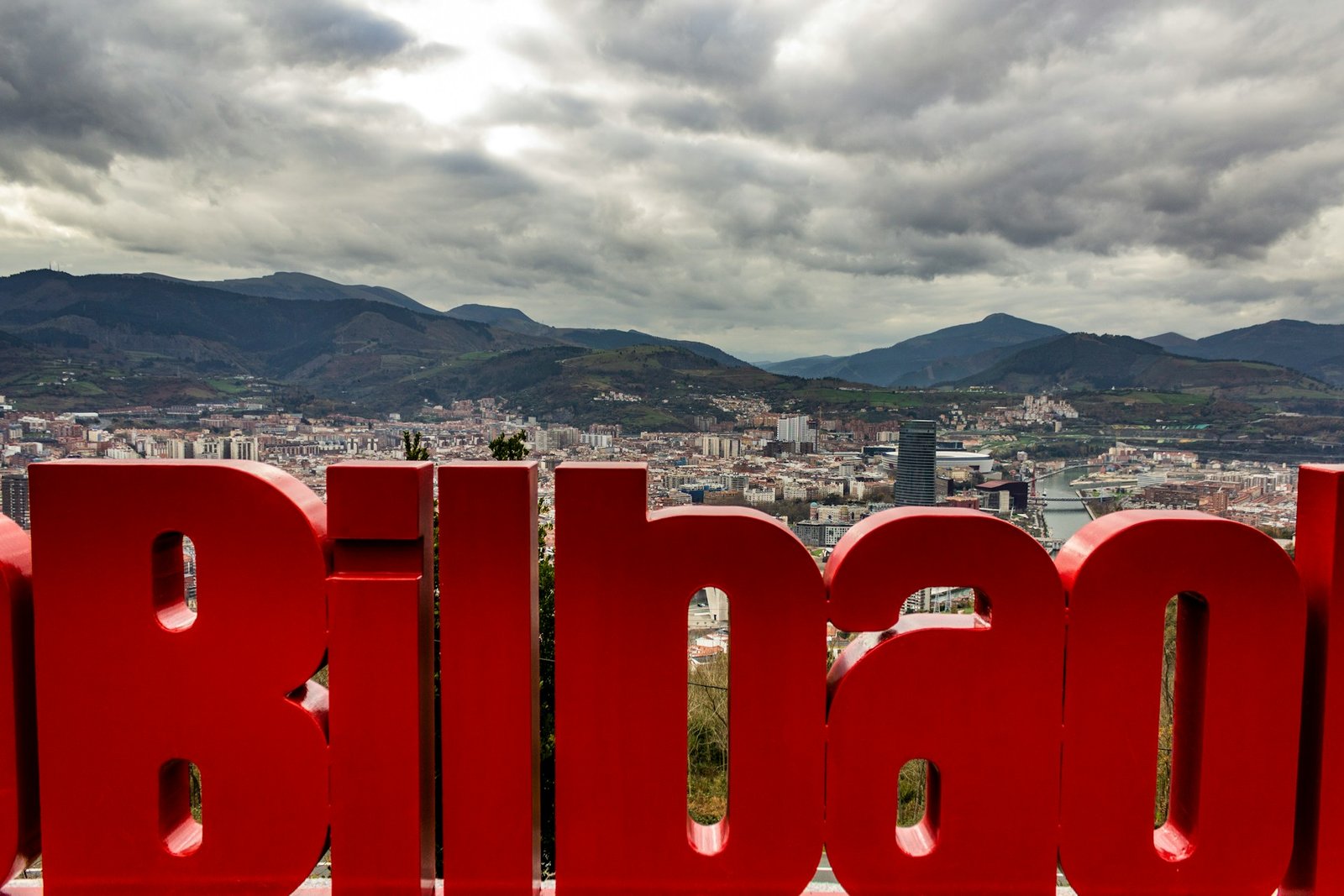
The Artxanda Funicular takes tourists to the top of Artxanda Mountain, where there is a sports complex, a hotel, a park, and several restaurants. During the trip, passengers can admire the panorama of Bilbao. The first funicular was built on this site in 1915. After the end of the Civil War, it was reactivated in 1938. The mechanism was activated for the third time in 1983 after modernization.
6. Basilica of Begoña
The people of Biscay consider the Blessed Virgin Mary of Begoña to be the patron saint of all sailors. In the 17th century, a basilica was erected in Bilbao in her honor. Particularly noteworthy is the gilded Baroque altar and the wooden statue of the Virgin Mary located in the center.
7. Cathedral of Saint James (Santiago Cathedral)
St. James’s Cathedral is a Gothic temple; construction began around 1300, even before the city of Bilbao itself was formally founded. At that time, there was a small fishing village on the site. The cathedral was built on one of the pilgrimage routes leading along the Way of St. James (Camino de Santiago). After 1374, it was rebuilt and expanded many times. It received the status of a cathedral only in 1950.
8. Church of Saint Nicholas (San Nicolás)
This temple is dedicated to Saint Nicholas of Bari (San Nicolás de Bari). Built in the 16th century, the church stands close enough to the river that its foundations and walls were historically damaged by flooding. In 1756, a new Baroque church was built on a solid stone pedestal. Inside the temple, there is an altar and sculptures by the sculptor Juan de Mena.
9. Museum of Fine Arts (Museo de Bellas Artes)
Unlike the modern Guggenheim Museum, the Museum of Fine Arts in Bilbao presents a more classic collection. It encompasses almost the entire history of Spanish art—from medieval sculptures to contemporary pop art. You can see the works of Francisco Goya, Bartolomé Esteban Murillo, El Greco, or José de Ribera, as well as many works by Basque painters. The museum regularly organizes exhibitions featuring works brought in from other countries.
10. Basque Museum
The museum was established in 1921 with the aim of protecting and preserving Basque culture. Its first collections came from donations from private individuals who donated, among other things, old furniture, clothes, family coats of arms, books, and various souvenirs. Currently, the collection contains thousands of exhibits. By visiting the museum, you will learn more about Basque culture, its traditions, the history of the region, and the development of the Basque language.
Other attractions worth seeing in Bilbao will be presented in the next part:)